Where to Buy Original Hearing Aids in Ra...
May 02, 2026
Why Choosing a Hearing Aid Feels So Confusing?
If you’ve started searching for hearing aids in Rawalpindi or hearing aids in Islamabad, you’ve likely noticed a pattern:
This creates real confusion:
The reality is simple but often misunderstood. The best hearing aid depends on your hearing loss, lifestyle, and technology level - not just size or price.
This guide breaks down the types of hearing aids, technology levels, and selection process in a clinically accurate but easy-to-understand way, so you can make an informed decision.
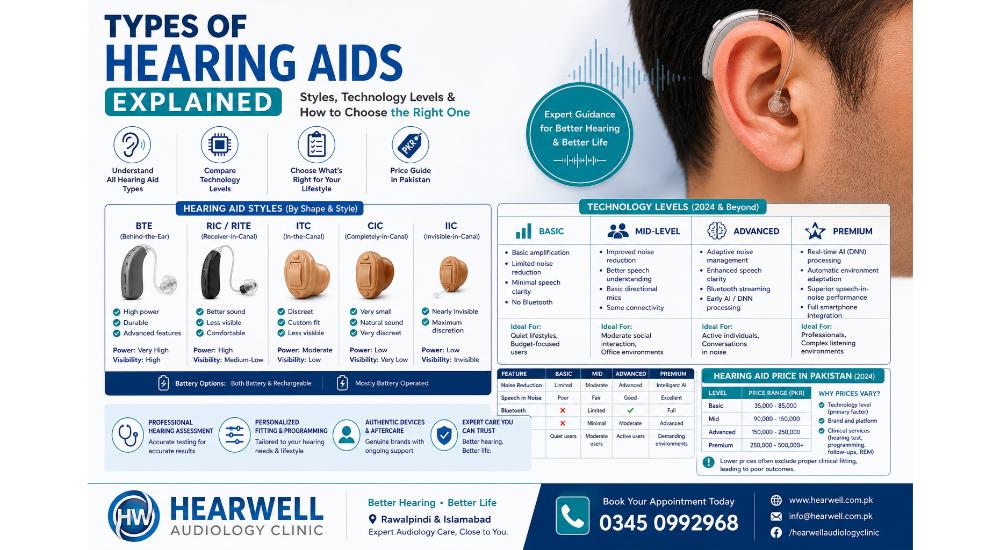
1. Types of Hearing Aids (By Shape & Style)
Understanding hearing aid types in Pakistan starts with their physical design. Each style has specific clinical indications.
1.1 BTE (Behind-the-Ear)
Description:
Sits behind the ear, connected to an earmold or dome via tubing.
Best For:
Pros:
Cons:
Cosmetic Factor: Low
Battery / Rechargeable:
1.2 RIC / RITE (Receiver-in-Canal)
Description:
A smaller BTE variant where the receiver sits inside the ear canal.
Best For:
Pros:
Cons:
Cosmetic Factor: Medium–Low visibility
Battery / Rechargeable:
1.3 ITC (In-the-Canal)
Description:
Custom-made device that fits partially inside the ear canal.
Best For:
Pros:
Cons:
Cosmetic Factor: High (less visible)
Battery / Rechargeable:
1.4 CIC (Completely-in-Canal)
Description:
Fits deeper into the ear canal, making it more discreet.
Best For:
Pros:
Cons:
Cosmetic Factor: Very high
Battery / Rechargeable:
1.5 IIC (Invisible-in-Canal)
Description:
Deepest fitting, nearly invisible device.
Best For:
Pros:
Cons:
Cosmetic Factor: Maximum
Battery / Rechargeable:
2. Hearing Aid Technology Levels
This is the most critical factor affecting performance.
2.1 Basic / Entry Level
Ideal For:
2.2 Mid-Level
Ideal For:
2.3 Advanced Level
Ideal For:
2.4 Premium Level
Ideal For:
Technology Comparison Table
|
Feature |
Basic |
Mid |
Advanced |
Premium |
|
Noise Reduction |
Limited |
Moderate |
Advanced |
Intelligent AI |
|
Speech in Noise |
Poor |
Fair |
Good |
Excellent |
|
Bluetooth |
No |
Limited |
Yes |
Full |
|
AI / DNN |
No |
Minimal |
Moderate |
Advanced |
|
Best For |
Quiet users |
Moderate users |
Active users |
Demanding environments |
3. Shapes vs Technology: The Biggest Misconception
A critical insight:
Shape ≠ Performance
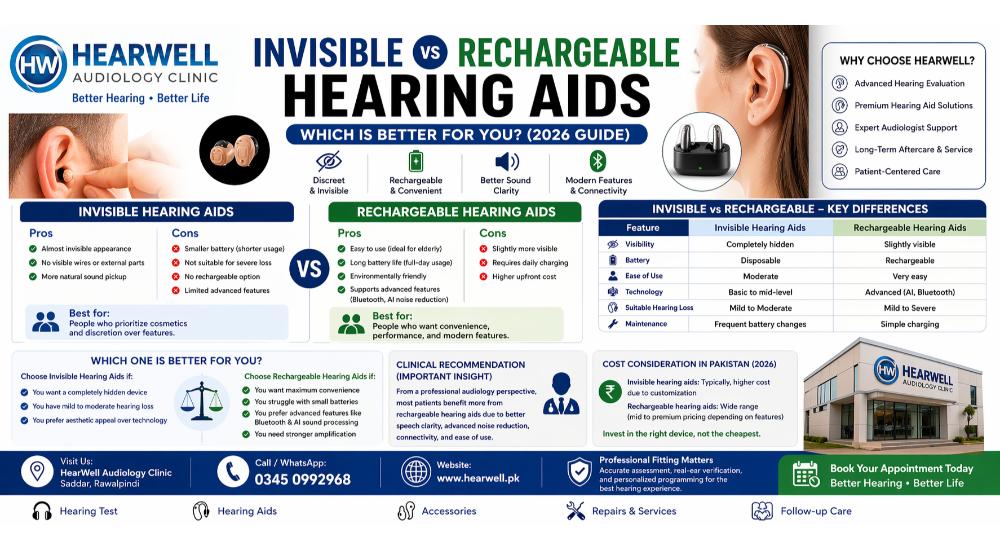
Many patients prioritize invisible hearing aids, assuming smaller is better. Clinically, that’s not accurate.
Trade-Off Reality
|
Factor |
Smaller Devices (CIC/IIC) |
Larger Devices (BTE/RIC) |
|
Power |
Low |
High |
|
Features |
Limited |
Advanced |
|
Battery |
Short |
Long / Rechargeable |
|
Connectivity |
Rare |
Common |
Conclusion:
4. Pros & Cons Summary Table
|
Type |
Visibility |
Power |
Comfort |
Features |
|
BTE |
High |
Very High |
Moderate |
Full |
|
RIC |
Medium |
High |
High |
Advanced |
|
ITC |
Low |
Moderate |
Moderate |
Limited |
|
CIC |
Very Low |
Low |
Moderate |
Minimal |
|
IIC |
Invisible |
Low |
Variable |
Minimal |
5. Hearing Aid Price in Pakistan
Understanding hearing aid price in Pakistan requires context.
Estimated Price Ranges
|
Level |
Price Range (PKR) |
|
Basic |
35,000 - 85,000 |
|
Mid |
90,000 - 150,000 |
|
Advanced |
150,000 - 250,000 |
|
Premium |
250,000 - 500,000+ |
Why Prices Vary
Lower prices often exclude proper clinical fitting, leading to poor outcomes.
6. How to Choose the Right Hearing Aid
A structured, clinical approach:
Step 1: Hearing Assessment
Step 2: Lifestyle Analysis
Step 3: Ear Anatomy
Step 4: Budget vs Value
Step 5: Professional Fitting
7. Common Mistakes to Avoid
Many low-cost digital hearing aids in Pakistan are not clinically programmed devices.
8. Hearing Aids in Rawalpindi & Islamabad: What Matters
When selecting providers locally:
Clinics offering personalized fitting and evidence-based programming consistently deliver better outcomes.
9. Subtle Recommendation: Clinical Approach Matters
For patients exploring hearing aids in Rawalpindi and hearing aids in Islamabad, a structured clinical pathway is essential.
At HearWell Audiology Clinic, emphasis is placed on:
Under the supervision of Syed Suleman Bukhari, AuD (Consultant Audiologist), the focus remains on long-term hearing outcomes rather than quick device sales.
10. Conclusion
There is no universal best hearing aid. The best device depends on your hearing profile.
Making the right choice requires clinical evaluation, not guesswork.
FAQs
1. Which hearing aid is best in Pakistan?
The best hearing aid depends on your hearing loss and lifestyle. Premium devices offer better performance in noise.
2. What is the difference between BTE and CIC?
BTE is more powerful with advanced features, while CIC is smaller but limited in performance.
3. Are invisible hearing aids effective?
They work well for mild to moderate hearing loss but lack advanced features.
4. How much do hearing aids cost in Pakistan?
Prices range from PKR 35,000 to 500,000+ depending on technology level.
5. Are rechargeable hearing aids better?
They offer convenience and are widely available in RIC and BTE styles.
6. Do I need an audiologist for hearing aids?
Yes. Proper testing and programming are essential for effectiveness.
7. Can I buy hearing aids online?
It is not recommended, as unprogrammed devices often provide poor results.


Comments (0)
Leave a Comment
No comments yet. Be the first to comment!